Updated 2026 • Based on Industry Studies

Cut your legal workload by up to 60%

A structured prompting method that tells AI exactly what to analyze, in what order, and with what weight — so the output is consistent, verifiable, and court-ready.
Instant Access
Ready-to-use digital system
Scales of Justice
60% Average time reduction (McKinsey & industry studies)
Information Security
Ethical and professional use
Section 1

Why most lawyers can't safely use AI yet

The problem isn't the technology. It's that generic AI tools were not built with legal liability in mind.

AI hallucinations are a professional liability

In Mata v. Avianca (S.D.N.Y. 2023), attorneys submitted ChatGPT-generated citations that did not exist. The court imposed sanctions. This is not an isolated incident — it reflects a structural problem: general-purpose AI has no mechanism to distinguish verified case law from plausible-sounding fabrication. Without a verification layer, any AI-assisted filing carries that risk.

Unstructured prompts produce inconsistent output
A generic prompt like "review this contract" gives different results every time. There is no weighting of risk factors, no structured output, no distinction between a material clause and a boilerplate one. Legal analysis requires a repeatable framework — the same way a due diligence checklist exists for a reason. Without structure in the input, there is no reliability in the output.

Confidentiality exposure is real and underestimated

Under ABA Model Rule 1.6 and GDPR Article 5(1)(f), attorneys are required to take reasonable measures to prevent unauthorized disclosure of client data. Pasting case documents into a public AI interface without understanding the data retention policy of that platform is a potential breach of that obligation — one that most bar associations have not yet issued formal guidance on, leaving individual attorneys exposed.

STRUCTURED AI FOR LAWYERS

Turn generic AI into a precise and reliable legal tool

Real Case Example: Contract Breach Analysis

Copy and paste this structured prompt into ChatGPT, Claude or Gemini:

ssh
Copy
Analysis = (Verifiable Facts 40% (chronological reconstruction of events based solely on documented and verifiable data, prioritizing established facts and linking them to the factual reality) + Contractual Risk Indicators 30% (Part A: objective evidence of onerous clauses, asymmetries, or unfair terms 15% + Part B: contingent liabilities, hidden financial risks, and disproportionate penalties 15%) + Missing Evidence at the Outset 20% (identification of documents, annexes, audit records, cross-communications, or financial statements that would have strengthened the breach claim from the start) + Explanation of Why it Was Difficult to Prove 10% (analysis of evidentiary obstacles, dispersion of contractual evidence, and lack of direct proof of performance in the initial phases without inventing laws or data, indicating "no record" if necessary))

This prompt delivers structured, professional, and court-ready analysis with clear weighting and zero hallucination bias.

Area-Specific Prompts

Contracts, litigation, compliance, due diligence and more. Optimized to minimize hallucinations.

Verification System

RAG methods, chain-of-thought and cross-validation to keep professional rigor.

Automated Workflows

From initial analysis to final drafting. Ready to use from day one.

What you get — exactly

Ready-to-use prompts for every legal area — Plus an AI that generates weighted prompts on demand, so every analysis is precise, structured, and free from invented case law.

The WSPM Prompting Method

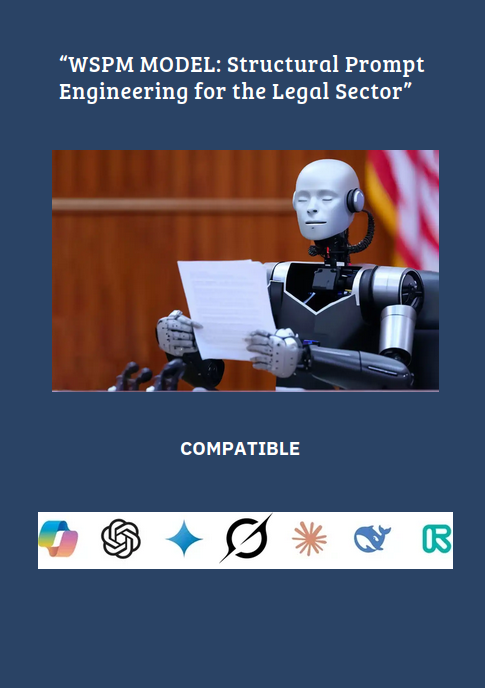
WSPM (Weighted Structured Prompting Method) is a prompting framework that breaks down any legal task into weighted components — telling the AI exactly what to prioritize, in what proportion, and in what sequence. The result is consistent, structured output every time, not a different answer depending on how you phrased the question that day.

Ready-to-Use Structured Prompts

Covering contracts, appeals, complaints, compliance and risk analysis. Each prompt is pre-weighted and pre-structured using the WSPM method — copy, paste, and get professional output immediately.

Anti-Error Protocols

Proven techniques to reduce hallucinations and boost accuracy.

Implementation Guide

How to integrate it in your firm from day one. No technical learning curve.

Data Protection
Data Protection

Your data stays yours. Always.

This system was built under the same legal standards it helps you apply. Here is exactly what that means in practice.

GDPR Article 5(1)(b) — Purpose Limitation

Personal data is collected for specified, explicit and legitimate purposes only. No client data submitted through this system is retained, stored, or processed beyond the immediate session. There is no secondary use of any kind.

GDPR Article 25 — Data Protection by Design and by Default

The system is architected so that only data strictly necessary for each specific task is processed. No data is shared with third parties, used for model training, or transferred outside the user's jurisdiction. This is not a policy statement — it is a technical constraint built into the workflow.

ABA Model Rule 1.6 — Confidentiality of Information

Attorneys are required to make reasonable efforts to prevent inadvertent or unauthorized disclosure of client information. Using an unstructured public AI interface without understanding its data retention policy is a potential breach of this obligation. This system is designed to operate within those constraints, not around them.

GDPR Articles 15–22 — Data Subject Rights

Users retain full rights of access, erasure, rectification and portability. No profiling or automated decision-making as defined under Article 22 is performed. The attorney remains the decision-maker at every step — the system produces structured analysis, never binding conclusions.

Directive (EU) 2016/680 — Professional Secrecy

All content processed remains subject to attorney-client privilege under applicable national bar association regulations. The use of this tool does not constitute a waiver of confidentiality under any applicable legal framework, including but not limited to EU, US and UK professional conduct rules.

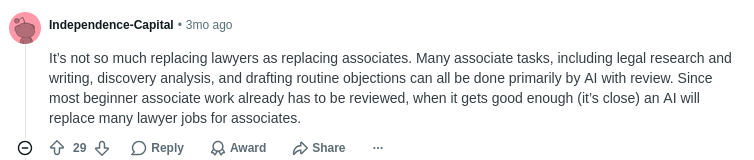
From the community

What lawyers are saying

reddit.com · r/lawyers
Reddit community feedback

Screenshot from a public Reddit thread. Not affiliated with Reddit Inc.

Start working smarter today

You get instant access to the full PDF guide, and future updates — for a one-time payment of $47.

If one structured prompt saves you one hour of drafting time, it has already paid for itself ten times over.